
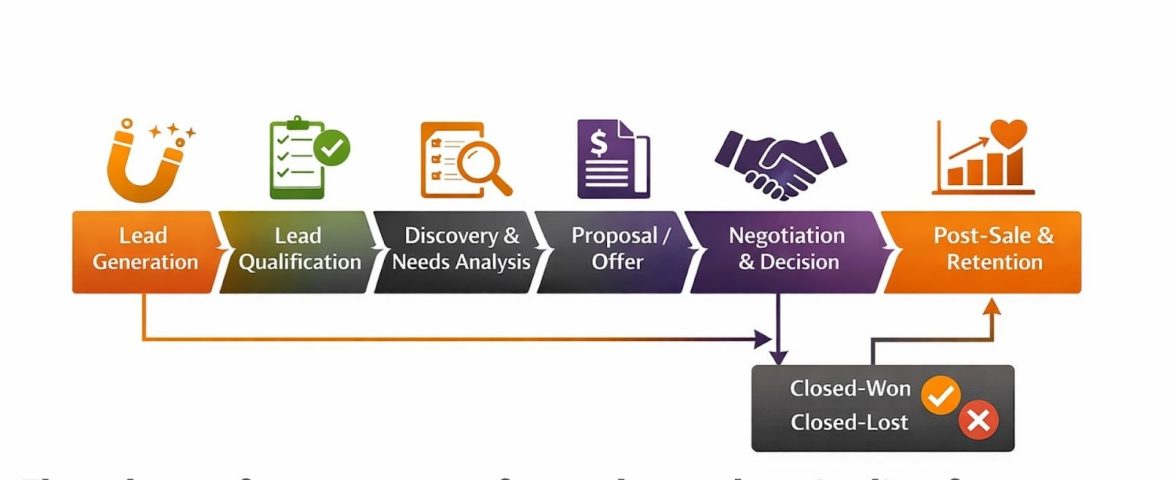
Complete Sales Pipeline for Scalable Business Growth
A complete sales pipeline is not just a visual representation of deals it is the operational backbone of scalable growth. For growing companies competing in international markets, an incomplete or poorly structured pipeline results in lost revenue, inaccurate forecasting, and inconsistent sales performance.
Modern growth-focused organizations treat their sales pipeline as a system, not a spreadsheet. When designed correctly, a complete sales pipeline aligns marketing, sales, automation, and data into one predictable revenue engine.
This article provides an analytical breakdown of what a complete sales pipeline should look like, supported by statistics, real-world examples, and best practices used by high-performing global teams.
What Is a Complete Sales Pipeline?
A complete sales pipeline is a structured, end-to-end framework that tracks a prospect’s journey from first interaction to closed deal and beyond.
Unlike basic pipelines, a complete sales pipeline:
- Reflects buyer intent at each stage
- Uses data-driven qualification methods
- Integrates automation and CRM logic seamlessly
- Provides clear visibility into revenue forecasting
According to Harvard Business Review, companies with a clearly defined sales pipeline experience 18% higher revenue growth than those without one.
Why Growing Companies Need a Complete Sales Pipeline
Growth introduces complexity. More leads, more channels, more markets and more opportunities for leakage.
A complete sales pipeline solves three major challenges:
1. Predictability: Accurate revenue forecasting
2. Efficiency: Sales teams focus only on high-intent leads
3. Scalability: Systems grow without breaking
McKinsey reports that organizations with structured sales processes are 33% more likely to outperform competitors.
Core Stages of a Complete Sales Pipeline
1. Lead Generation
This stage captures inbound and outbound leads from SEO, ads, referrals, and partnerships.
Key metrics:
- Traffic-to-lead conversion rate
- Cost per lead (CPL)
2. Lead Qualification
Not all leads are equal. A complete sales pipeline filters prospects using predefined criteria such as budget, authority, need, and timing.
Qualified leads convert 50% faster than unqualified leads (HubSpot).
3. Discovery & Needs Analysis
Sales teams assess pain points, objectives, and readiness to buy. This stage determines deal viability.
4. Proposal / Offer Stage
Clear pricing, scope, and value propositions are presented. Automation can trigger follow-ups and reminders.
5. Negotiation & Decision
Objections are handled, terms are finalized, and buying signals are monitored.
6. Closed-Won / Closed-Lost
Deals are either converted or archived; both outcomes provide valuable data.
7. Post-Sale & Retention
A truly complete sales pipeline doesn’t stop at conversion. Upsells, renewals, and referrals drive long-term growth.
Retention-focused companies grow revenues 25–95% faster than acquisition-only businesses.
Complete Sales Pipeline vs Incomplete Pipeline
| Incomplete Sales Pipeline | Complete Sales Pipeline |
| Manual lead tracking | CRM-based lead tracking |
| Inconsistent qualification | Data-driven qualification |
| Manual follow-ups | Automated follow-ups |
| Guesswork forecasting | Predictive forecasting |
| Limited scalability | High scalability |
Automation’s Role in a Complete Sales Pipeline
Automation eliminates delays and human error.
Key automation elements:
- Instant lead assignment
- Follow-up sequences
- Deal stage movement
- Sales alerts
According to Salesforce, sales teams using automation report 14.5% higher productivity.
How Agencies Build Complete Sales Pipelines for Global Clients
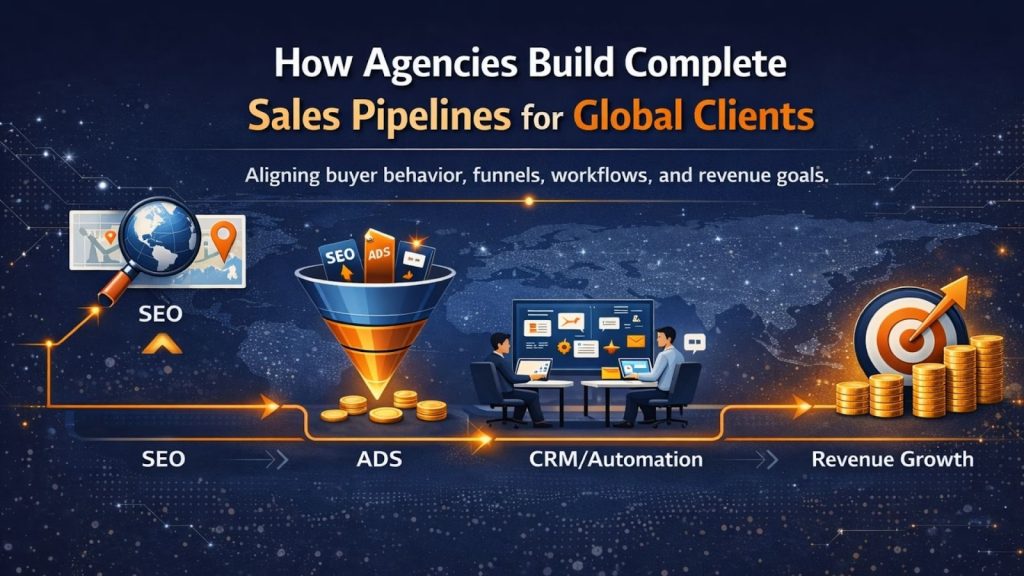
High-performing agencies don’t just “set up CRMs.”
The architect aligned with:
- Market-specific buyer behavior
- Funnel entry points (SEO, ads, referrals)
- Sales team workflows
- Revenue goals
This strategic approach allows international clients to scale confidently across regions.
Common Mistakes Growing Companies Make
- Skipping qualification stages
- Mixing marketing and sales stages
- No defined exit criteria
- Ignoring post-sale stages
These gaps silently limit growth.
Future of the Complete Sales Pipeline
As AI and predictive analytics mature, sales pipelines will become:
- Intent-driven
- Self-optimizing
- Revenue-predictive
Companies that invest early in structured pipelines will dominate their markets.
Final Thoughts
A complete sales pipeline is not optional for growing companies it is foundational. From lead generation to retention, every stage of a complete sales pipeline must be intentional, measurable, and scalable to support long-term growth.
Organizations that treat their complete sales pipeline as a strategic asset rather than a static chart build predictable revenue engines capable of competing globally. By leveraging expert-led sales pipeline frameworks and automation-focused services like those available at ebabra, growing companies can transform fragmented sales efforts into structured, conversion-driven systems.

Leave A Comment